What Is AEO? Answer Engine Optimization vs GEO, Explained
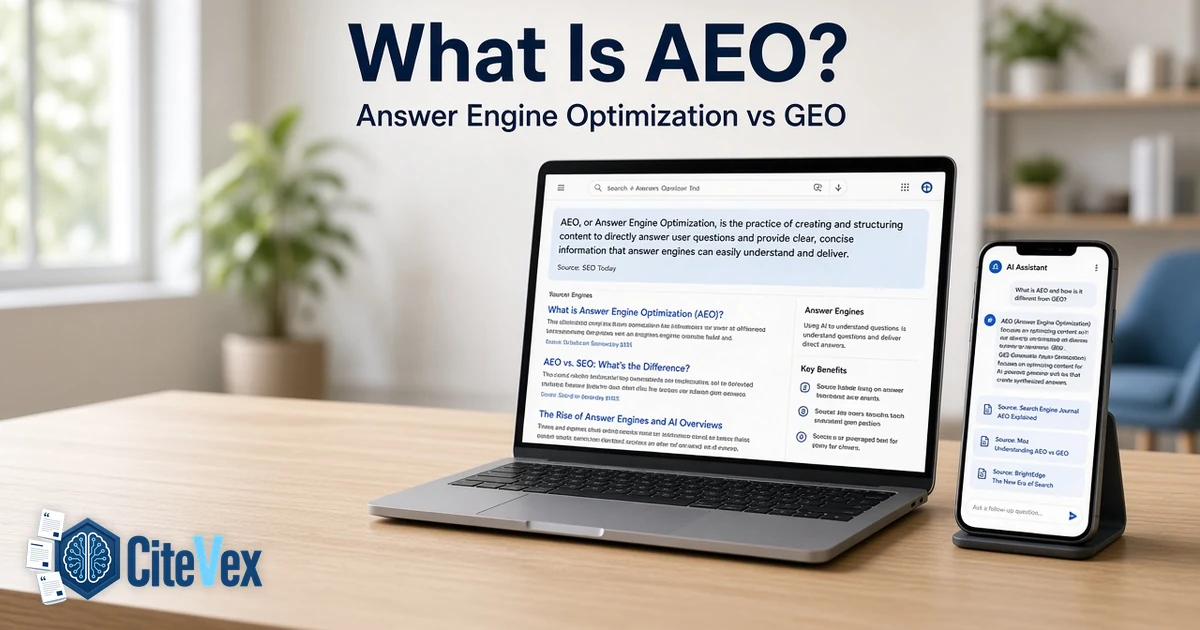
AEO (answer engine optimization) is the work of making your brand and content easy for AI answer engines such as ChatGPT, Perplexity, Gemini, Microsoft Copilot, and Google AI Overviews to find, understand, and cite. GEO (generative engine optimization) describes the same goal. Both build on SEO, then add one question: when an AI writes the answer, is your brand in it?
If you want help with the off-site half of that work, our AEO agency page explains how Citevex approaches it. This guide covers the definitions, the real differences, and where to start.
What does AEO mean?
AEO stands for answer engine optimization. An answer engine is any system that responds to a question with a written answer instead of a list of ten links. Early AEO work focused on featured snippets and voice assistants. Today the term mostly refers to large language model (LLM) products: ChatGPT, Perplexity, Gemini, Claude, Copilot, and Google’s AI Overviews and AI Mode.
AEO has two parts:
- On-site. Clear answers near the top of the page, headings that match real questions, accurate facts, crawlable pages, and structured data that matches what readers see.
- Off-site. Being named, accurately and often, on the third-party pages these engines retrieve: best-of lists, statistics pages, reviews, forum threads, and long-standing editorial articles.
Most published advice covers the first part. For commercial questions like “best payroll software for small teams,” the second part usually decides which brands get named.
What does GEO mean?
GEO stands for generative engine optimization. The term comes from a research paper by Pranjal Aggarwal and colleagues at Princeton and IIT Delhi, first posted in 2023 and published at the KDD 2024 conference. The authors built a benchmark of 10,000 queries and tested how changes to a source page affected its visibility inside generative answers.
Their headline result is useful and often overstated. Adding citations, quotations from relevant sources, and statistics improved a page’s visibility in generated answers by up to 40% in their benchmark, and by up to 37% in a test on Perplexity. The gains varied by domain, and the “up to” figure is an upper bound, not an average. Keyword stuffing did not help.
You will also see GEO used in a second, unrelated sense: geographic targeting. If you landed here searching “what does geo mean” for maps or local ads, that is a different topic.
AEO vs GEO: is there a real difference?
In practice, no. Agencies and tool vendors use the two labels for the same job, and you will see AI SEO, LLM SEO, and ChatGPT SEO used the same way. Where people do draw a line, it usually looks like this:
| AEO | GEO | |
|---|---|---|
| Origin | Industry term, older, tied to snippets and voice search | Academic term from the 2023 GEO paper |
| Typical focus | Being the cited answer to a specific question | Being included and described well in a synthesized answer |
| Common tactics | Direct answers, FAQ structure, entity clarity | Citations, statistics, quotations, presence on sources the engine retrieves |
| Measured by | Citations and mentions per prompt | Share of voice across a prompt set |
Pick the term your team or clients already use. The work is the same.
What Google says about AEO and GEO
Google addressed both terms directly in its 2026 guide to optimizing for generative AI features in Search. Its position: from Google Search’s point of view, optimizing for AI features is still SEO. AI Overviews and AI Mode are rooted in Google’s core ranking and quality systems, and Google uses retrieval-augmented generation (it calls this grounding) plus “query fan-out,” which runs several related searches across subtopics before writing a response.
The same guide lists things you can ignore for Google Search:
- llms.txt files and other special AI markup (Google Search does not use them)
- “Chunking” content into tiny pieces for AI
- Rewriting content in a special style just for AI systems
- Seeking inauthentic mentions across the web
- Treating structured data as required (it helps with rich results but is not needed for AI features)
To be eligible as a supporting link in AI Overviews or AI Mode, a page must be indexed and eligible to show a snippet in Google Search. As of 2026 a site must also be included in the “Search generative AI” setting in Search Console, which is on by default.
That is Google’s view of Google. ChatGPT, Perplexity, Claude, and Copilot use their own retrieval systems and partners, so AEO work also has to cover crawler access for those engines and the sources they lean on.
How AI answer engines choose what to cite
There are two ways a brand ends up in an AI answer.
Retrieval at answer time
ChatGPT search, Perplexity, Copilot, and Google’s AI features fetch live pages when they answer. The brands they name are largely the brands named on the pages they retrieve. Ahrefs found in July 2025 that 76% of AI Overview citations came from pages in Google’s top 10. Its March 2026 update, using a larger dataset and better parsing, put that figure at about 38%, with the rest split between positions 11 to 100 and pages outside the top 100. Ahrefs links the shift to query fan-out: Google is citing pages that rank for related sub-queries, not only the original one.
Training data
Base models also carry what they learned in training. That knowledge changes only when a model is retrained, and it favors brands that are described consistently across many reputable pages over a long period.
What the cited pages have in common
Studies of citation sources keep finding the same patterns. In an Ahrefs study of 75,000 brands, branded web mentions had the strongest correlation with visibility in AI Overviews (Spearman 0.664), well ahead of backlinks (0.218). A March 2026 analysis by Peec AI, published on Wix’s AI Search Lab, looked at more than one million citations from ChatGPT, Google AI Mode, and Perplexity and found that listicles made up about 41% of citations for commercial-intent prompts, while long-form articles led for informational prompts.
The practical reading: for “what is” questions, engines cite explainers. For “best” and “which” questions, they cite lists and comparisons. Both are mostly third-party pages.
AEO vs SEO: what actually changes
| Traditional SEO | AEO / GEO | |
|---|---|---|
| Unit of success | A ranking position and a click | A mention or citation inside an answer |
| Main surface | Your own pages | Your pages plus the third-party pages engines retrieve |
| Off-site signal | Backlinks, mostly | Brand mentions (linked or not), plus backlinks |
| Measurement | Rankings, clicks, conversions | Prompt tracking, share of voice, cited URLs, plus Search Console’s Generative AI performance report |
| Content style | Comprehensive pages for a keyword | Direct answers, specific facts, original data |
SEO is not replaced. A page that is not indexed, crawlable, and trusted will not be retrieved. AEO adds a layer on top that pays closer attention to who else is talking about you.
The click picture also changes. A Pew Research Center analysis of March 2025 browsing data found users clicked a traditional result on 8% of Google visits that showed an AI summary, against 15% when none appeared, and clicked a link inside the summary on just 1% of those visits. Being named in the answer matters more when fewer people scroll past it.
How to start with AEO
- Build a prompt set. List 20 to 50 questions buyers ask before choosing a product like yours. Pull them from sales calls, support tickets, and Search Console queries.
- Run a baseline. Ask each question in ChatGPT, Perplexity, Gemini, Copilot, and Google. Record which brands appear, how they are described, and which URLs are cited. A spreadsheet works; AI search visibility tools help once the list grows.
- Fix access and facts on your site. Allow search crawlers such as Googlebot, Bingbot, OAI-SearchBot, and PerplexityBot. Put a clear, current description of what you do on your key pages.
- Map the cited sources. For each prompt, list the third-party pages being cited. These are your targets.
- Earn presence on those sources. Pitch editors of listicles, contribute data to statistics pages, correct and link existing mentions, and publish original research worth citing.
- Re-run monthly. AI answers vary between runs, so track trends across many prompts, not single screenshots.
For a step-by-step version focused on Google, read how to rank in AI Overviews.
Frequently asked questions
What is AEO in simple terms?
AEO means making sure AI tools that answer questions, such as ChatGPT or Google AI Overviews, can find your content and mention your brand accurately when someone asks about your topic.
What is GEO in marketing?
GEO, or generative engine optimization, is the practice of improving how often and how well your brand or content appears in answers written by generative AI search engines. It is a near synonym for AEO.
Is AEO replacing SEO?
No. AI engines retrieve from search indexes, so pages still need to be crawlable, indexed, and trusted. Google states that its AI features rely on the same ranking and quality systems as regular Search. AEO extends SEO; it does not replace it.
Do I need llms.txt or special schema for AEO?
Not for Google. Google says its Search features, including AI Overviews and AI Mode, ignore llms.txt and need no special markup. Other AI companies have not confirmed that they rely on llms.txt either, so treat it as optional.
How long does AEO take to show results?
Retrieval-based engines can reflect a new citation as soon as the source page is recrawled, sometimes within weeks. Changes in how a model describes your brand from training data take longer and depend on retraining cycles. No one can promise a specific timeline or citation.
Can an agency guarantee AI citations?
No. AI answers are generated on the fly, vary between runs, and depend on systems no outside party controls. A credible AEO agency promises process, placements, and transparent tracking, not citations.