Unlinked Brand Mentions: How to Find Them and Turn Them Into Links
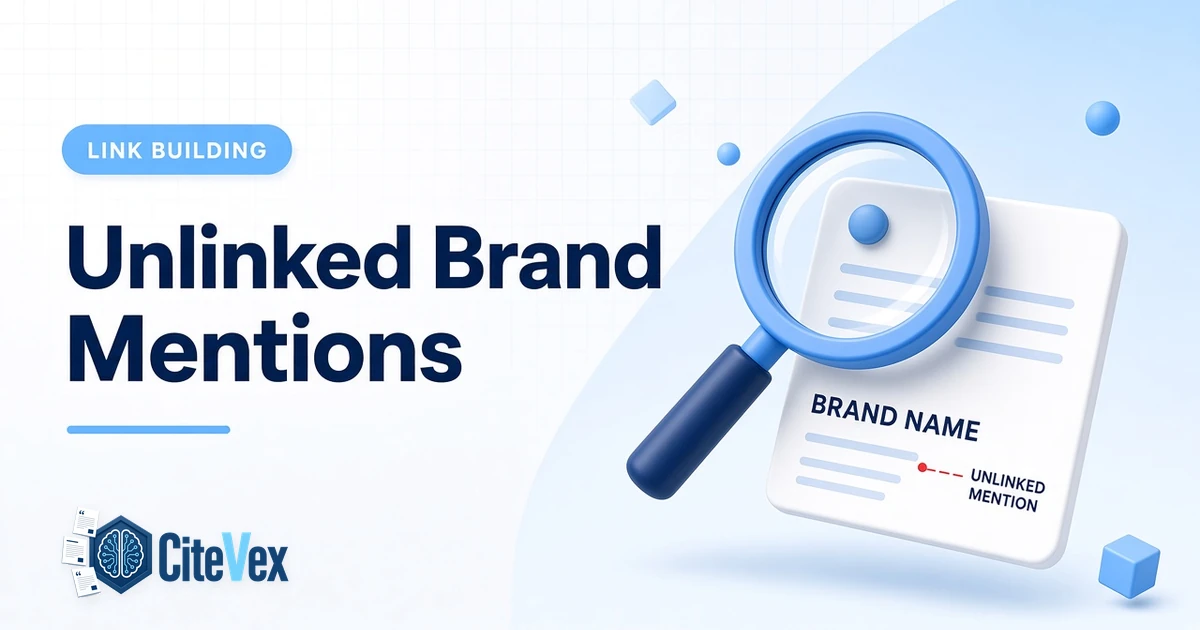
An unlinked brand mention is a page that names your brand, product, or people without linking to your website. Converting them is usually the easiest link building there is, because the publisher has already chosen to write about you. You find them with search operators and mention-monitoring tools, filter for pages with real traffic, then ask the author politely to add a link where it helps readers.
Unlinked mention reclamation is part of our historical brand mentions service. Here is how to do it yourself.
Why unlinked mentions are worth your time
- High conversion. You are asking for a small edit on content that already features you, not a new placement.
- Existing authority. Many mentions sit on aged pages that already rank and are already crawled.
- AI accuracy. AI engines summarize what pages say about you. Finding mentions lets you correct outdated pricing, old product names, or wrong descriptions before they get repeated in answers.
- Mentions already help. An Ahrefs study of 75,000 brands found branded web mentions correlated with AI Overview visibility (0.664) more strongly than backlinks did (0.218). A link on top of that mention adds referral traffic and ranking value.
In Editorial.Link’s 2026 survey, 80.9% of 518 SEO professionals said they believe unlinked mentions affect organic rankings. Google has not confirmed how it treats them, so think of the link as the bonus and the accurate mention as the base value.
How to find unlinked brand mentions
Free methods
Google search operators. Search for your brand in quotes while excluding your own site and common profiles:
"YourBrand" -site:yourbrand.com -site:linkedin.com -site:x.com -site:facebook.com
Add variations: product names, founder names, old brand names, common misspellings, and your domain written as text ("yourbrand.com"). Use the Tools menu to limit results to the past year for fresher mentions.
Google Alerts. Set alerts for your brand and product names. Coverage is incomplete, but it is free and catches new mentions.
Search Console. The Links report shows sites linking to you, which helps you rule out pages that already link.
Your own records. Press coverage lists, partner pages, podcast appearances, conference speaker pages, and customer case studies often mention you without a link.
Paid tools
- Ahrefs Content Explorer. Search your brand name, filter by “one article per domain,” and use the option to highlight unlinked domains. Sort by traffic or Domain Rating.
- Ahrefs Brand Radar. Tracks brand mentions on the web and in AI answers in one place.
- Semrush Brand Monitoring. Tracks new mentions and lets you filter for unlinked ones.
- Brand24, Mention, Talkwalker. Media monitoring tools with alerting, sentiment, and social coverage.
Image and data mentions
Two often-missed sources:
- Your images. Use a reverse image search (Google Lens, TinEye) on your original charts, infographics, and photos. Sites that use them without credit are strong reclamation targets.
- Your statistics. Search distinctive numbers from your studies in quotes. Writers often cite the figure but not the source. See link building statistics for how data spreads.
How to prioritize which mentions to chase
Not every mention is worth an email. Score each one quickly:
| Factor | Chase | Skip |
|---|---|---|
| Page traffic | Has organic traffic | No traffic, no rankings |
| Relevance | Topic matches your product | Passing mention in an unrelated piece |
| Site quality | Real editors, clean outbound links | Spun content, link-selling footprint |
| Context | Recommends, cites, or reviews you | Negative or neutral list of names |
| Accuracy | Correct, or wrong in a way you can fix | Accurate and already linked elsewhere on the page |
| Contact | Author or editor reachable | No contact route |
Also flag mentions that are inaccurate, even on low-traffic pages. If AI engines retrieve them, the errors spread.
How to ask for the link
Find the right person
The author of the piece is usually best, then the section editor. Check the byline, author page, or the site’s contact page. Avoid generic “info@” addresses when you can.
Keep the request short and useful
Make the link about the reader, not about you. Point to the most relevant page, which is often a specific product page, study, or guide rather than your homepage.
Template: simple link request
Subject: Thanks for mentioning [Brand] in “[Article title]” Hi [Name], Thanks for including [Brand] in your piece on [topic]. Readers who want to try [the specific thing you mentioned] can find it here: [URL]. If you think it would help them, would you consider linking to it where we’re mentioned? Either way, thanks for the coverage. [Your name, role]
Template: correction plus link
Subject: Small update for “[Article title]” Hi [Name], Thanks for featuring [Brand]. One detail has changed since you published: [old fact] is now [new fact] ([source URL]). If you update the piece, a link to [URL] would point readers to the current details. Happy to answer any questions. [Your name, role]
Template: image or data credit
Subject: Source for the [chart / statistic] in “[Article title]” Hi [Name], I noticed you used our [chart / figure on X] in your article, which is great to see. The original study is here: [URL], with the full methodology. Would you be open to adding a source credit with a link? [Your name, role]
Follow up once
Send one follow-up after about a week. If there is no reply, move on. Repeated chasing damages the relationship and your brand.
What not to do
- Do not demand a link or imply the mention is unauthorized when it is not.
- Do not ask for exact-match keyword anchors. Brand name or a descriptive phrase reads naturally and avoids the optimized-anchor pattern that Google’s link spam policy calls out.
- Do not offer payment for the link. If a publisher asks for a fee, the link would need to be tagged sponsored or nofollow under Google’s rules, which changes what you are getting.
- Do not mass-email every mention with the same template.
Tracking and reporting
Keep a simple log: URL, date found, page traffic, contact, date emailed, follow-up date, outcome, and whether you also requested a correction. Review it monthly. Over time, the log also tells you which publications write about your category most, which feeds your digital PR and listicle outreach.
To see whether mentions are changing AI answers, rerun a fixed set of buyer prompts monthly. Our guide to AI search visibility tools covers manual and paid options.
Frequently asked questions
What is an unlinked brand mention?
A reference to your brand on another website that does not include a hyperlink to your site.
How do I find unlinked mentions for free?
Use Google search with your brand in quotes, excluding your own domain and social profiles, and set up Google Alerts. Paid tools such as Ahrefs Content Explorer and Semrush Brand Monitoring are faster and more complete.
What conversion rate should I expect?
It varies by industry, relationship, and how useful the link is to readers. Mentions where you can also correct outdated information tend to convert better than plain link requests.
Should I link to my homepage or a specific page?
Link to the page that best matches what the article mentions. A specific product, study, or guide is usually more helpful to readers than a homepage.
Do unlinked mentions help SEO without a link?
Google has not confirmed a direct ranking effect. Mentions do correlate with visibility in AI Overviews and help engines understand what your brand is associated with.